StiMic: Electrical stimulation in epileptic patients; optimisation of electrical parameters with multiscale recordings
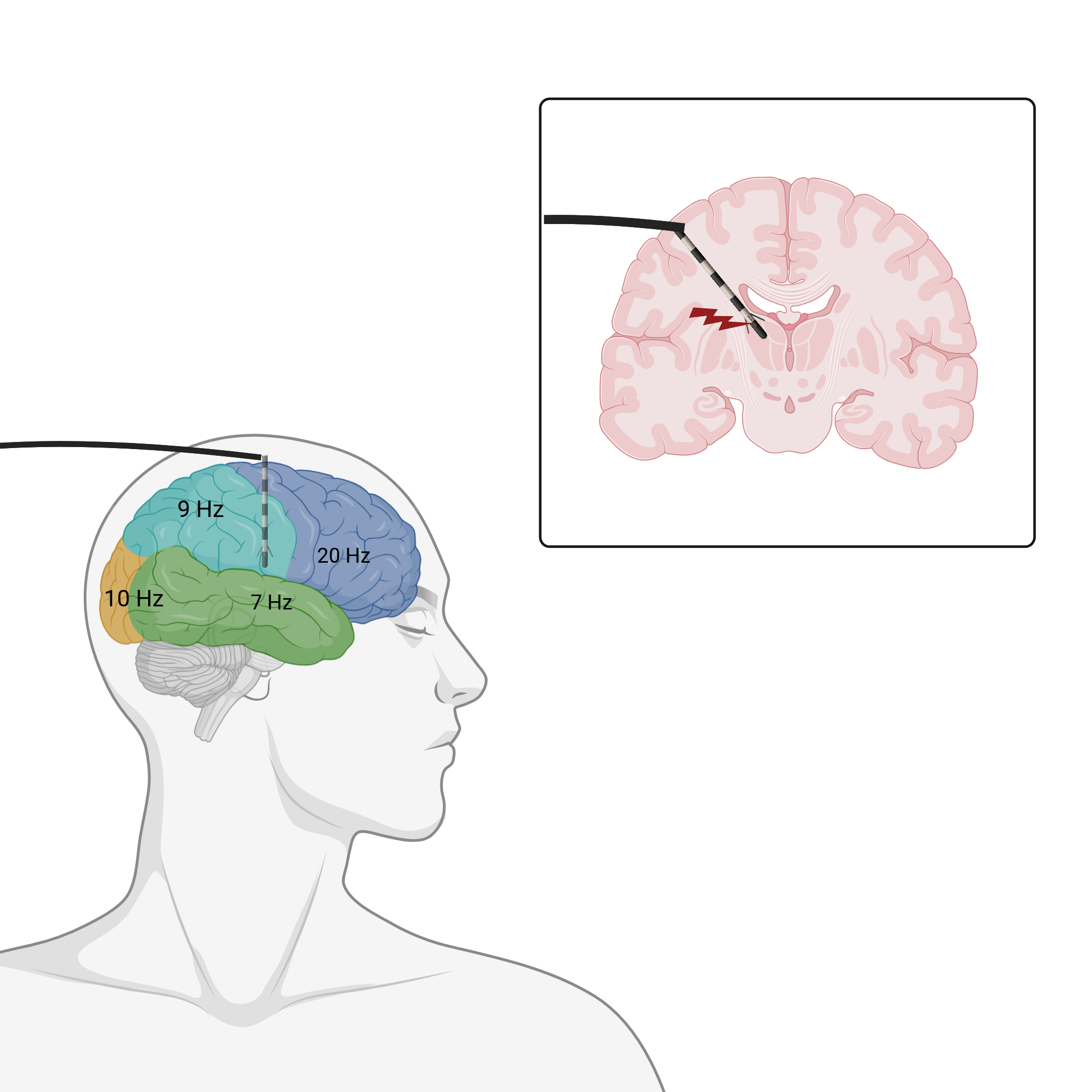
During SEEG, epileptic patients go through electrical brain stimulations. This routine procedure contributes to delineating epileptogenic networks, studying brain connectivity, and performing functional mapping. However, stimulation effects remain unpredictable, with false-negatives, false-positives, and a lack of reproductibility in responses induced. As of today, electrical parameters used remain empirical, and underlying neuronal mechanisms are not yet fully understood.
(i) We aim to optimise electrical parameters (frequency, duration, …) to improve clinical results and patients comfort. The StiMiC protocol includes additional EBS with frequencies based on physiological frequency bands prevailing in each lobe (e.g., theta in temporal regions), with the aim of better entraining local activity.
(ii) Stimulation sessions are recorded with micro-macro electrodes, allowing for better characterisation of stimulation effects on local and remote micro-circuits.
Article published
Darves-Bornoz, A., Barbeau, E. J., Denuelle, M., Calvel, A., De Barros, A., Darrasse, Z., Guines, K., Lotterie, J.-A., Valton, L., & Curot, J. (2026). Theta-range SEEG stimulation for intracranial mapping: Extending conventional 1-Hz and 50-Hz protocols. Clinical Neurophysiology, 191, Article 2112350. https://doi.org/10.1016/j.clinph.2026.2112350
PhD: Aube Darves-Bornoz
PIs: Jonathan Curot, Emmanuel Barbeau
Fundings:
ANR Effects of intracranial electrical brain stimulation on neuronal dynamics recorded by tetrodes microelectrodes in epileptic patients – DYNEUMICS

LFCE 4th year PhD grant for Aube Darves-Bornoz:
Effets de la stimulation électrique intracrânienne sur les dynamiques neuronales enregistrées par des microélectrodes chez des patients épileptiques.